
Praying Mantis Care Guide for Beginners
Enclosure setup, humidity, live insect feeding, and molting care for a pet Praying Mantis — a remarkable, alien-like invertebrate pet.
Overview
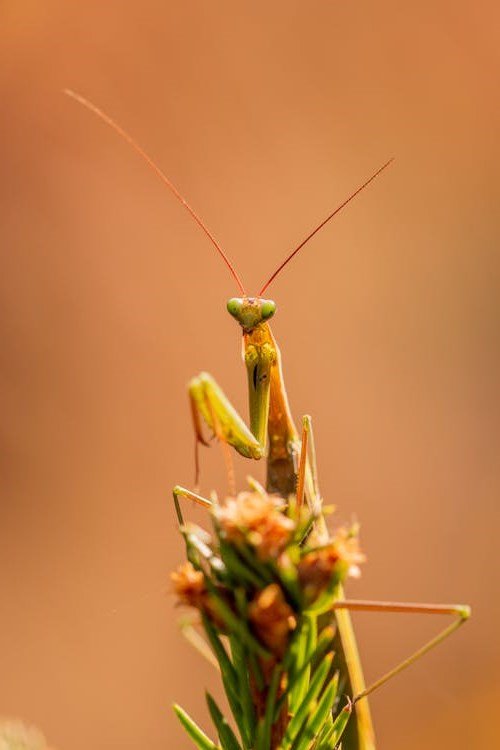
Praying Mantises are some of the most fascinating creatures you can keep as pets. They have triangular heads that rotate 180°, powerful spiked arms that strike faster than the human eye can follow, and eyes that seem to watch and track your every movement.
They are completely harmless to humans. They have no venom and their arms are designed to grip insects, not human skin.
For beginners, the Chinese Mantis (Tenodera sinensis) or European Mantis (Mantis religiosa) are the best starting points. They are large, robust, and easy to find.
Habitat & Housing
Height is the most critical thing in a mantis enclosure. The mantis must be able to hang upside-down from the top with at least 3× its body length of space below it. It needs this space to molt.
If the enclosure is too short, the mantis cannot fully emerge from its old skin. This causes permanent deformity or death.
Enclosure size rule: at least 3× the mantis body length in height, and 2× in width and depth.
Ventilation: cross-ventilation (mesh on two sides) is essential. Good airflow prevents mold and respiratory problems.
Add a twig or fake plant running from the substrate to the top. This gives the mantis a walking path and a launching point.
Temperature and humidity (varies by species):
| Species | Temperature | Humidity |
|---|---|---|
| Chinese / European | 65–80°F | 30–50% |
| Orchid Mantis | 77–86°F | 60–80% |
Diet & Feeding
Mantises eat only live, moving prey. They will not eat dead insects.
Best prey:
- Flies (fruit flies for small mantises; bottle flies for adults)
- Crickets — must be smaller than the width of the mantis’ head
- Dubia roaches — excellent nutrition
Feed every 2–3 days. The mantis will fast before molting — this is normal.
Never put two mantises in the same enclosure. They are cannibalistic and will eat each other immediately.
Molting
Molting is the most important moment in a mantis’ life.
The mantis will stop eating 1–7 days before molting. Then it will hang motionless upside-down from the very top of the enclosure. This is the pre-molt position — do not touch it.
The molt itself takes 30 minutes to a few hours. The mantis pulls itself out of its old skin while hanging. If disturbed, the molt fails — the mantis comes out deformed or dies.
After molting, the new skin is soft. Do not offer food for 24–48 hours. Do not handle during this time.
A successful molt results in a larger mantis with intact, perfect limbs.
Health & Common Issues
A healthy mantis is alert, reactive to movement, and holds its raptorial arms cleanly folded.
Failed molt: caused by insufficient height in the enclosure or too-low humidity. This is why correct enclosure setup is everything.
Dehydration: mantis looks shriveled and moves slowly. Lightly mist one wall so it can drink droplets.
Mold: usually from overfeeding. Remove uneaten prey promptly and improve ventilation.
Handling & Temperament
Mantises can be handled briefly. They are curious and will examine your face by tracking your movements with their head.
- Approach from the front so it can see you
- Let it step onto your hand — do not grab
- Keep sessions to 10–15 minutes
- Some adult mantises have wings and can fly — handle in a contained space
Mantises are purely observational pets. They get no benefit from handling. It is simply a treat for the owner.
Cost & Commitment
| Item | Cost |
|---|---|
| Mantis (captive-bred) | $10–$60 |
| Enclosure | $15–$50 |
| Monthly live insects | $10–$20 |
Most temperate mantis species live 8–12 months as adults. Tropical species can live 18–24 months. They are short-lived but deeply interesting pets.
Frequently Asked Questions
Are Praying Mantises venomous?
No. Mantises have no venom. They kill prey purely by grip and physical force. They are completely safe for humans.
Can I keep male and female mantises together?
Only briefly for mating. Females often eat males before, during, or after mating. This is normal behavior. Never permanently house two mantises together.
How do I know my mantis is about to molt?
It will stop eating 1–7 days before. Then it will hang motionless upside-down from the top of the enclosure. This is the sign. Do not disturb it at all.
Can mantises fly?
Adult mantises of some species have wings and can fly. Adult males especially tend to fly. Handle winged adults in a contained space.